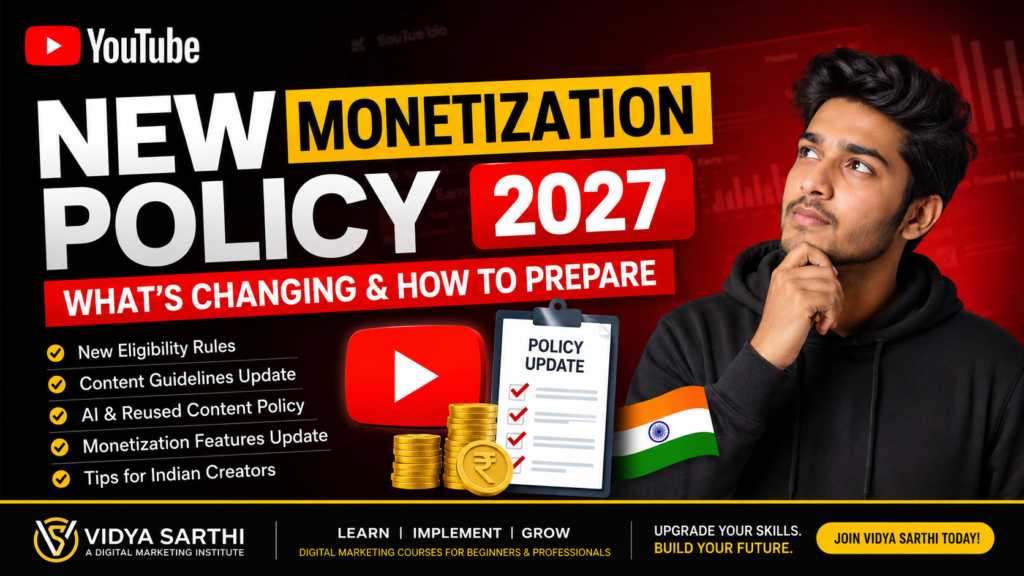
YouTube Monetization Policy 2027: What Indian Creators Need to Know
YouTube has changed the game for creators. Here’s what Indian YouTubers should know about monetization, AI content, reused videos and original content before 2027.
YouTube is no longer just a platform for entertainment. For thousands of Indians, it has become a serious career option, side income source and even a full-time business.
From gaming and education to vlogging, finance, beauty, cooking and Shorts, Indian creators are building audiences every day. But as the platform grows, YouTube is also becoming more careful about what type of content qualifies for monetization.
This has created a lot of confusion around the so-called “YouTube Monetization Policy 2027.”
So, is YouTube introducing a completely new monetization policy in 2027?
At present, creators should be careful about claims suggesting that YouTube has already announced a completely new 2027 monetization policy. The latest official changes currently available focus strongly on originality, authentic content, mass-produced content, reused content and advertiser-friendly videos. YouTube updated its “repetitious content” policy in July 2025 and renamed it “inauthentic content.”
For Indian creators, the bigger message is simple:
Don’t just create more content. Create better and more original content.
Let’s understand what this means.
1. What Is Changing for YouTube Creators?
The biggest concern for creators is content that looks mass-produced, repetitive or copied.
YouTube says monetized content should be original and authentic. Videos should provide something useful, educational or entertaining rather than simply being produced to generate views.
This is particularly important now because AI tools have made it extremely easy to produce videos.
For example, a creator can use AI to:
- Write a script
- Generate a voice
- Create images
- Make a video
- Add subtitles
- Create a thumbnail
- Upload multiple videos every day
The technology itself is not necessarily the problem.
The problem starts when dozens of videos look almost identical and offer very little original value.
YouTube specifically gives examples such as repetitive story videos, templated slideshows and mass-produced content with minimal variation.
2. Is AI Content Banned on YouTube?
No. AI content is not automatically banned from monetization.
This is one of the biggest misunderstandings among creators.
YouTube has stated that creators can use AI tools to enhance storytelling and that channels using AI can remain eligible for monetization, as long as they follow the platform’s monetization policies.
Think of AI as a tool.
Using AI to help you brainstorm ten video ideas is very different from pressing a button and publishing fifty almost identical videos.
For example, imagine an Indian education channel.
Good approach:
You research a topic, use AI to organize your ideas, add your own examples, explain concepts in your own style, edit the video and provide useful information.
Risky approach:
You generate 100 scripts with almost the same structure, use the same AI voice, same visuals and same storytelling format, then upload them every day with only the topic changed.
The second approach can look like mass-produced content.
So, going into 2027, creators should focus on AI-assisted creativity rather than AI-generated repetition.
3. What About Reused Content?
Another important area is reused content.
Reused content means taking existing content from YouTube or another online source and republishing it without adding significant original commentary, modification or educational or entertainment value.
This can be a major problem for channels that depend heavily on:
- Movie clips
- TV clips
- Instagram videos
- TikTok-style compilations
- Sports clips
- Other YouTubers’ videos
- News footage
- Viral videos
Simply downloading a video, adding background music and uploading it again doesn’t make it original.
However, reused content can sometimes be monetizable when there is a meaningful transformation.
For example, YouTube lists critical reviews, reaction videos with commentary, educational explanations and substantially edited footage with added storytelling as examples of content that can qualify under its reused-content rules.
The important question is:
“What did I add to this content?”
If the answer is simply “a different thumbnail and background music,” that’s not enough.
If you added analysis, commentary, education, storytelling or substantial creative editing, you have a much stronger case.
4. Shorts Creators Also Need to Be Careful
Shorts have become extremely popular in India because they can reach large audiences quickly.
But getting millions of views doesn’t automatically mean that every view is eligible for monetization.
YouTube’s Shorts monetization policies also require creators to follow its rules regarding original and reused content. Non-original Shorts, such as unedited clips, reuploads and compilations without original content, can be ineligible for revenue sharing.
So if you’re running a Shorts channel in 2027, don’t build your entire strategy around copying viral videos.
Instead, create your own:
- Hooks
- Scripts
- Voiceovers
- Commentary
- Visuals
- Editing style
- Stories
- Ideas
You can still follow trends. Just add your own personality to them.
5. Originality Will Become More Important
One of the biggest lessons creators should take from the current YouTube policies is that originality matters more than simply uploading frequently.
Having the same intro or outro isn’t automatically a problem.
YouTube explains that similar formats can still be monetized when the actual substance of each video is meaningfully different.
For example, a cooking channel can have the same intro in every video.
But:
Video 1: How to make butter chicken
Video 2: How to make South Indian sambar
Video 3: How to make homemade paneer
The format is similar, but the actual content is different.
The problem would be uploading hundreds of videos that are almost identical with minimal changes.
So don’t be afraid of having a consistent channel style.
Consistency is good. Repetition without value is the problem.
6. What Indian Creators Should Do Differently
For Indian creators, there are huge opportunities in regional and local content.
You don’t need to make another generic “Top 10 Facts” channel.
You can create content around:
- Indian education
- Government schemes
- Career guidance
- Digital marketing
- Indian startups
- Personal finance education
- Food
- Travel
- Technology
- Beauty
- Fitness
- Regional languages
- Indian culture
- Gaming
- Local businesses
- Skill development
The advantage of Indian creators is the size and diversity of the audience.
You can create content in Hindi, English, Hinglish or regional languages and build a specific community.
For example, instead of creating a generic digital marketing video called “What is SEO?”, you could make:
“SEO for Indian Small Businesses: How a Local Shop Can Get Customers from Google.”
That immediately adds a specific audience, context and purpose.
7. Don’t Chase Views at the Cost of Your Channel
Another important lesson for 2027 is to avoid shortcuts.
Buying subscribers, generating fake engagement or using artificial traffic can put your channel at risk.
YouTube also considers issues such as fake engagement, invalid traffic and other policy violations when dealing with monetization and earnings.
Instead of asking:
“How can I get 1 million views?”
Ask:
“How can I make 10,000 people genuinely want to watch my next video?”
That mindset creates a much stronger channel.
8. Your Content Should Pass the “Human Test”
Here’s a simple test creators can use before uploading a video.
Watch your video and ask:
“Does this feel like something a real creator made for a real audience?”
If the answer is yes, you’re moving in the right direction.
Ask yourself:
- Did I add my own perspective?
- Is the information useful?
- Is the script genuinely different?
- Are the visuals appropriate?
- Did I edit the video creatively?
- Is there a reason for someone to watch until the end?
- Would I personally watch another video from this channel?
If every answer is yes, you’re building a healthier channel.
9. A Simple Monetization Checklist for 2027
Before publishing your next YouTube video, keep this checklist in mind:
Original idea → Original script → Useful information → Creative editing → Authentic presentation → Properly licensed visuals/music → No fake engagement → No unnecessary repetition
This doesn’t guarantee monetization because YouTube reviews channels according to its complete policies.
But it gives creators the right direction.
Also remember that YouTube reviews the channel as a whole. Reviewers may consider areas such as the channel’s main theme, most-viewed videos, newest videos, watch-time-heavy content, metadata and About section.
That means one good video isn’t enough if the rest of the channel is full of problematic or repetitive uploads.
10. What Should You Do Now?
If you’re already a YouTuber, don’t panic and delete your entire channel just because you’ve heard about a “2027 policy.”
Instead, audit your existing content.
Look at your most-viewed videos and ask:
Is this content original?
Did I add real value?
Am I using someone else’s content without enough transformation?
Are many of my videos basically the same?
Am I using AI as a creative tool or simply mass-producing videos?
Fix the weak areas and start improving your content quality.
And if you’re planning to start a YouTube channel, this is actually a great time to learn the skills behind content creation, SEO, social media marketing, analytics and audience growth.
Build Skills That Go Beyond YouTube
YouTube is only one part of digital marketing.
If you want to understand how content, SEO, social media, paid advertising, analytics and branding work together, learning digital marketing can give you a much bigger advantage.
Vidya Sarthi, a digital marketing institute, can help beginners and aspiring professionals develop practical digital marketing skills and understand how these platforms work in the real world.
Want to build a career in digital marketing and learn skills that can help you grow online? Explore Vidya Sarthi’s digital marketing courses and start upgrading your skills today.
Final Thoughts
The biggest takeaway for 2027 is not that YouTube is “stopping” creators from using AI or making Shorts.
The real direction is towards original, authentic and valuable content.
AI can help you work faster.
Templates can help you stay consistent.
Trends can help you get discovered.
But none of them can replace your ideas, creativity, knowledge and personality.
For Indian creators, the opportunity is still massive. But the creators who build sustainable channels will be the ones who stop looking for shortcuts and start building genuine value for their audience.
So, if you’re thinking about starting a YouTube channel in 2027, remember one simple rule:
Don’t create content just because you can. Create content because you have something worth sharing.
That is the kind of content that can build viewers, trust, a community and, eventually, a real digital career.
Note: YouTube’s policies can change. This article is based on the official YouTube monetization information currently available and should not be treated as a guarantee of future 2027 policy changes.