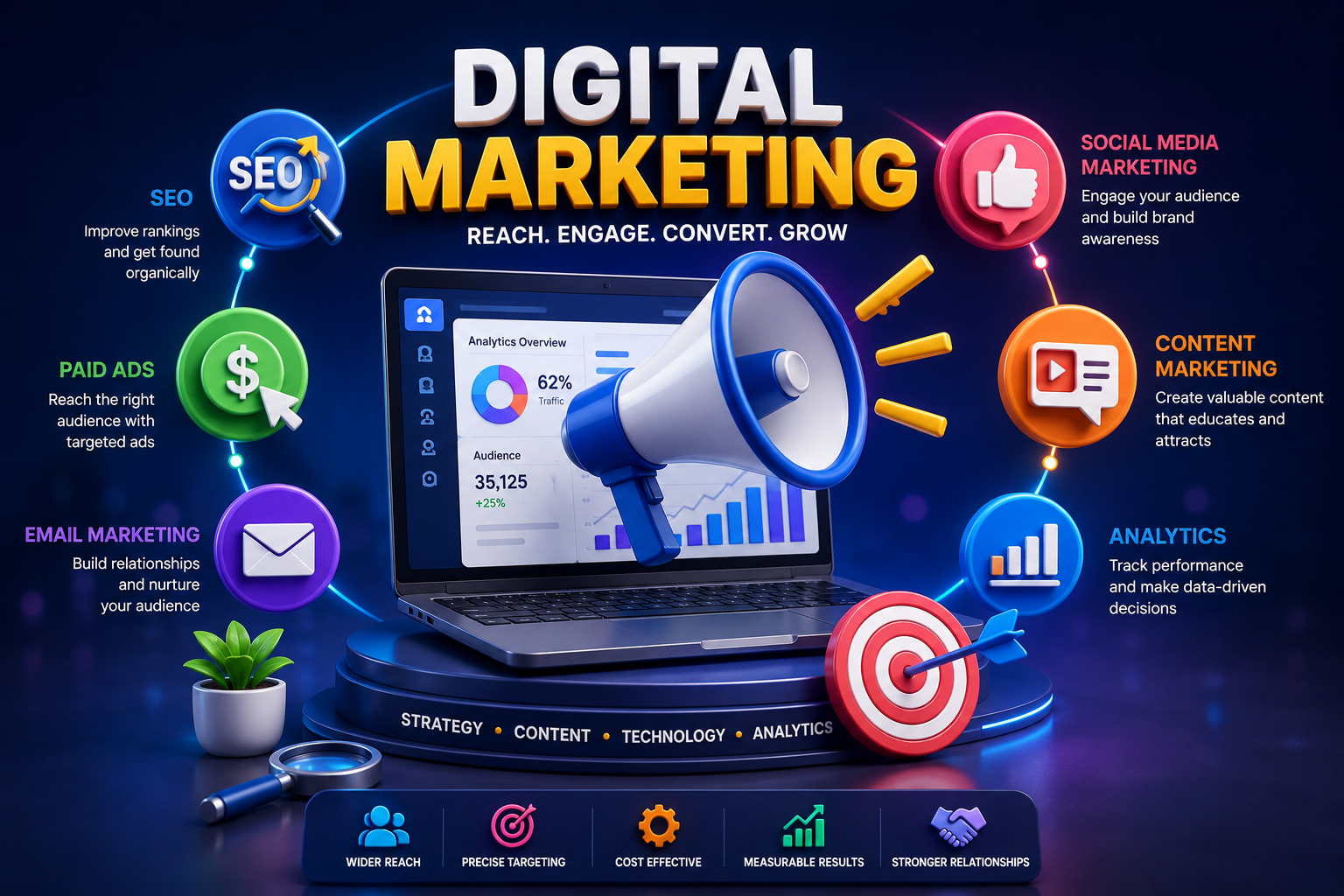
What Is Digital Marketing? Types, Benefits & Channels
Online Advertising has become an important part of how businesses reach customers today. Whether you discover a brand through a Google search, see an Instagram post, watch a YouTube advertisement, or receive a promotional email, you are interacting with digital marketing.
But what is digital marketing, exactly? In simple words, digital marketing is the promotion of products, services, brands, or businesses through digital channels such as search engines, websites, social media, email, mobile applications, and online advertising.
Unlike traditional marketing, digital marketing allows businesses to reach specific audiences, track campaign performance, and make changes based on data. This makes it useful for both large companies and small businesses.
What Is Digital Marketing?
DM refers to marketing activities carried out through digital platforms and technologies to connect businesses with their target audience.
For example, imagine a small clothing store in Faridabad. Instead of depending only on people passing by its physical shop, the business can create an Instagram page, build a website, appear in Google search results, run online advertisements, and send offers to customers through email or WhatsApp.
All these activities can become part of a Onlinw marketing strategy.
According to Google, digital marketing includes channels such as search, social media, email, and paid advertising, with marketers using data to understand performance and improve campaigns.
The main purpose is not simply to get more views or followers. A good digital marketing strategy connects business goals with customer needs and encourages useful actions such as visiting a website, making an enquiry, signing up, or purchasing a product.
How Does Digital Marketing Work?
Digital marketing generally starts with understanding the target audience and setting a clear business objective.
A business may want to:
Increase brand awareness
Generate leads
Increase website traffic
Get more sales
Build customer relationships
Promote a new product or service
Once the objective is clear, marketers select suitable digital channels and create content for their audience.
For example, a business selling skincare products may use SEO to appear in Google searches, Instagram to demonstrate products, Google Ads to reach people with purchase intent, and email marketing to communicate with existing customers.
The performance of these activities can then be measured using metrics such as website traffic, clicks, engagement, conversions, and return on advertising spend.
This makes digital marketing a continuous process. Marketers can analyse results, identify what is working, make improvements, and test new approaches.
Types of Digital Marketing
1. Search Engine Optimization (SEO)
SEO is the process of improving a website and its content so that it can gain visibility in organic search results.
For example, if someone searches for “digital marketing course in Faridabad,” an institute can use relevant content, technical SEO, useful pages, and other optimization techniques to improve its chances of appearing in search results.
SEO can help businesses attract people who are already searching for information, products, or services related to their business.
2. Search Engine Marketing and Paid Advertising
Paid advertising allows businesses to pay for visibility on platforms such as search engines and social media.
Google Ads is one example. A business can create advertisements targeting particular keywords, audiences, locations, or customer interests.
Paid advertising can provide faster visibility than waiting for organic rankings, but businesses need to manage their budgets and campaign performance carefully.
3. Social Media Marketing
Social media marketing involves promoting a business through platforms such as Instagram, Facebook, LinkedIn, YouTube, and other social networks.
Businesses can use social media to:
Build brand awareness
Share educational content
Engage with customers
Promote products
Generate leads
Drive traffic to their websites
For small businesses, social media can also provide a relatively accessible way to build relationships with their target audience.
4. Content Marketing
Content marketing focuses on creating useful and relevant content for a specific audience.
Examples include:
Blog posts
Videos
Guides
Infographics
Case studies
Social media posts
E-books
Instead of constantly telling customers to buy something, content marketing can provide information that helps them solve problems and make decisions.
5. Email Marketing
Email marketing allows businesses to communicate directly with people who have subscribed or otherwise provided permission to receive messages.
Businesses can use emails for newsletters, product updates, offers, educational content, and customer communication.
Personalized and relevant emails can help businesses maintain relationships with existing customers.
6. Affiliate and Influencer Marketing
Affiliate marketing involves working with partners who promote a business’s products or services, often earning a commission for resulting sales or leads.
Influencer marketing involves collaborating with creators who have an established audience. Their content can introduce a product or brand to people who trust their recommendations.
Benefits of Digital Marketing
There are several benefits of DM for businesses of different sizes.
Wider Reach
Digital platforms allow businesses to reach people beyond their immediate geographical area. A local business can target customers in its city, while an online business can potentially reach customers across different regions or countries.
Better Audience Targeting
Digital platforms provide businesses with different targeting options. Depending on the platform, marketers may be able to reach audiences based on factors such as location, interests, search behaviour, or previous interactions.
Measurable Results
One of the biggest advantages of digital marketing is measurement.
Businesses can monitor metrics such as:
Website visitors
Click-through rates
Engagement
Leads
Conversions
Cost per acquisition
Return on advertising spend
This information helps marketers understand whether their campaigns are producing useful results.
Cost Flexibility
Digital marketing can work with different budgets. A small business can begin with organic social media content or SEO and gradually invest in paid advertising as its goals and resources grow.
However, having a small budget does not automatically guarantee success. Strategy, content quality, targeting, and consistency still matter.
Personalised Communication
Digital channels make it possible to create more relevant experiences for customers.
For example, a customer who has previously purchased from a business may receive an email about related products, while a new visitor may see educational content designed to introduce the brand.
Builds Long-Term Relationships
Digital marketing is not only about getting a single sale. Businesses can use content, social media, email, and other channels to remain connected with customers after a purchase.
This can support customer loyalty and encourage repeat business.
Digital Marketing vs Traditional Marketing
Traditional marketing includes channels such as television, newspapers, magazines, radio, and outdoor advertising. Digital marketing uses online and digital channels such as websites, search engines, social media, email, and digital advertisements.
One major difference is measurement and interaction.
For example, a newspaper advertisement may reach many people, but it can be difficult to know exactly how many readers became customers because of that particular advertisement.
Digital marketing can provide detailed performance data such as impressions, clicks, conversions, and customer interactions.
However, this does not mean traditional marketing is useless. Depending on the target audience and business objective, traditional and digital methods can work together.
Why Is Digital Marketing Important Today?
Customers increasingly use digital platforms to discover information, compare products, read reviews, communicate with businesses, and make purchases.
Because of this behaviour, businesses need to understand where their customers spend time online and how they search for information.
This type of marketing helps businesses become visible in these digital environments.
For students and professionals, learning digital marketing can also open opportunities in areas such as SEO, social media marketing, content marketing, paid advertising, email marketing, analytics, and e-commerce.
Businesses and marketers are also increasingly using AI and data-driven tools to improve research, content creation, campaign analysis, and marketing decisions. Google similarly highlights the growing role of AI and analytics in modern digital marketing.
Conclusion
The key is not to use every digital channel simply because it is available. Successful digital marketing begins with understanding the audience, setting clear goals, creating useful content, choosing the right channels, and continuously measuring and improving performance.
For anyone who wants to understand how modern businesses attract and communicate with customers, digital marketing is an essential skill to learn.
Ready to Learn Digital Promotions?
Understanding E – marketing is the first step. The next step is learning how to apply it in real projects.
If you want to develop practical skills in SEO, Google Ads, social media marketing, content marketing, analytics and AI-powered marketing, explore Vidya Sarthi’s AI-Powered Marketing Course.
Start learning. Build practical skills. Grow your digital marketing career.